


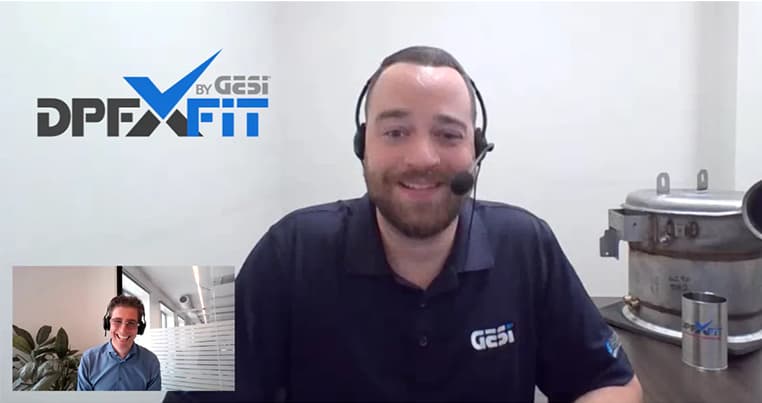
Why did Global Emission Systems build their B2B webshop directly on their ERP system?
When Global Emission Systems was looking for a solution for their B2B webshop, they chose Abakion because the webshop is built directly on the company's ERP system, which was something many other vendors only claimed to be able to do, but couldn't deliver in practice when the API or connection had to be tested.
For Connor Pritchard, program and project manager at Global Emission Systems, that is the difference that counts, and his advice to others is to do the same, preferably earlier than Global Emission Systems itself did. The webshop has since cut price and availability inquiries by around 75 percent and made it possible to launch new parts far faster than before.
Global Emission Systems is a privately owned company with locations in both the USA and Canada. They make aftertreatment solutions for virtually all commercial combustion engines: on-road, off-highway, power generation, and marine backup power.
What is the Amazon effect, and why did it push Global Emission Systems to build a webshop?
The Amazon effect is, as Connor Pritchard, program and project manager at Global Emission Systems, calls it, the expectation customers in North America have of being able to log in, check stock, and order parts themselves. They want the information immediately.
A truck pulls into the workshop, it needs to move on, and the mechanic needs a specific part now. If it's in stock, it can arrive tomorrow. The customer doesn't want to pick up the phone, send an email, or wait. And if he has to wait because the information isn't readily available, he simply goes to the next supplier.
This was especially a problem for Global Emission Systems because they were last to market with their brand, DPF X-Fit. Three major competitors had come before them, and all of them had a webshop.
When the company hired a new VP of commercial heavy duty, the most frequent comment from his first year in the field was exactly the same: you're missing a webshop. Some customers wouldn't even onboard Global Emission Systems as a supplier without one.
The market demanded it, the competitors had it, and the company wasn't quite sure how best to approach it.
What was the goal of Global Emission Systems' new B2B webshop?
The goal of Global Emission Systems' new webshop was an intuitive platform with correct product data, built using the same approach the company already used on the product side: best product, best packaging, best warranty, best customer service. Now the best platform also had to be delivered: beautiful, intuitive, and easy to use.
The big challenge was correct product information. Global Emission Systems supports both their own brand and a number of private labels, and at the headquarters in Ontario they produce goods in a so-called blank format, without brand and packaging.
The webshop had to show the right information across all of that. In the early conversations, the ERP vendor believed that this exact issue would become a major obstacle, which made it a bit daunting to find a webshop that both suited the business and looked good.
How did Global Emission Systems prepare their data for the webshop?
Global Emission Systems prepared the webshop by starting from data the company already had internally, drawing inspiration from the industry leader, Amazon. Customers needed to be able to see price, stock, images, and all references.
Cross-references are especially important for an aftermarket manufacturer, because the customer often searches by the original equipment manufacturer's number and needs to be able to find the corresponding part. Global Emission Systems already had all that data internally. The webshop just needed to display the information that was already there.
It's worth mentioning that the implementation came shortly after the company had rolled out Microsoft Business Central across the entire organization in 2023. Connor Pritchard led that project, and the webshop felt like a mini version of the same exercise.
Could a standard solution cover Global Emission Systems' business?
Yes, the concern turned out to be unfounded, but it weighed heavily on Connor Pritchard in the early phases of the project, precisely because the experience from the ERP implementation created hesitation. During that project, Connor Pritchard had encountered a number of things that were unique to the business and didn't exist out of the box. So when the webshop project got underway, the same questions came back: Will the standard solution work for us? Are the customers who already use it in the same situation as us, or are we too special?
The concern lingered in the back of his mind through the early phases. There had to be processes that an off-the-shelf solution couldn't cover.
What results has the webshop given Global Emission Systems?
The webshop has given Global Emission Systems two major results. Around 75 percent fewer inquiries about price and availability, and a far faster path to market for new products.
The customer service team still gets some emails, but the inquiries that were about price and availability have dropped by around 75 percent, because the webshop answers them.
The biggest change, however, lies in how new products come to market.
Previously, Global Emission Systems distributed price files in Excel. The moment the email was sent, the file was frozen in time, and customers had to upload a lot of data into their own system. So they would typically wait until 10, 15, or 20 parts were ready before sending out a new file. That could take six months, and during that period the company didn't sell the new parts, because the market didn't know they existed.
With the webshop, it's different. When a customer searches for an OEM number, the system cross-references the correct part, and a new product shows up immediately. The customer discovers that the part is available, even though it wasn't on the price file.
As soon as a new part is launched, Global Emission Systems adds the price group and master data, runs an update, and the part is out there living. This has made it possible to push forward with product development instead of waiting for the next big price file.
How does customer feedback turn into features that benefit all of Global Emission Systems' customers?
At Global Emission Systems, customer feedback turns into features for all customers, because requests from individual customers are, as a rule, built into the product itself rather than remaining one-off customizations.
When the webshop first went live, it showed global stock across all locations. But customers in western Canada, who handle 90 percent of their own pickups, didn't care what was in Whitby or North Carolina. One customer said it plainly: "the portal is good, but we won't use it unless we can see where the stock is located."
That became one of the first customization projects: stock shown per location. And here lies a point that extends beyond Global Emission Systems. These kinds of requests don't turn into one-off customizations, but into additions to the product itself, which all customers benefit from.
The feature can be activated on a single customer's site within a few minutes, and then it shows stock per location for those who need it.
It also goes the other way. Connor Pritchard has himself benefited from features that other customers previously initiated, including the ability to see multiple levels in assembly bills of materials.
Looking back, the only thing Connor Pritchard would have done differently is launch earlier. Almost every single customization the company requested came from market feedback that only became clear after the portal was out. When you're sitting on the vendor's side of the table, it's evidently not always obvious until the customer points it out.
Can Connor Pritchard change content in the webshop's backend himself?
Yes, Connor Pritchard can go in and correct some of the information that he would otherwise have to ask a vendor to change. That was something that surprised him more than anything else.
One example was the button in the shopping cart that read "order". Customers were afraid to click it, because they thought the order would be placed before they could enter an order number and delivery address, for example in the case of dropshipping. They called and asked where the item was actually being sent.
Connor Pritchard contacted Abakion to get the text changed, and in a Teams meeting, Theo showed him that he could simply go into the translation section in the B2B admin and write it himself.
Traditionally, getting a webshop built involves an endless series of emails back and forth. Can you change this, and this? Being able to go in and adjust it yourself, without depending on the vendor, means a lot, not least when the parties are sitting in vastly different time zones with holidays and everything in between.
Connor Pritchard's next step is to invest a bit more time in the backend part of the webshop.
What is Connor Pritchard's recommendation to others considering a B2B webshop?
Connor Pritchard's recommendation is to build the webshop on the data the company already has in its ERP system. If you have the structure and the data in place, there's great value in letting the webshop draw directly on them instead of building a new dataset alongside it. That was the difference that made Global Emission Systems choose the solution, and it's also what Connor Pritchard emphasizes when he talks to others.
And his clearest recommendation isn't about whether to do it, but about when. Had he met the Abakion team earlier, the webshop would have gone live a year sooner.
Frequently asked questions
Why did Global Emission Systems choose Abakion for their B2B webshop?
Because the webshop is built directly on Global Emission Systems' ERP system, which according to Connor Pritchard is the decisive difference, when many other vendors only claimed to be able to connect to the ERP system without actually being able to.
What is the Amazon effect?
The Amazon effect is the expectation customers in North America have of being able to log in, check stock, and order parts themselves, with the information available immediately, without having to call, email, or wait for a response.
How much did Global Emission Systems' customer service inquiries drop after the webshop's launch?
Inquiries about price and availability dropped by around 75 percent, because the webshop now answers them instead of the customer service team.
How long did it previously take to launch new parts at Global Emission Systems, and how long does it take now?
Previously it could take up to six months, because new parts were only added to the market once 10, 15, or 20 parts were ready for a combined price file. With the webshop, a new part can be made available as soon as the price group and master data are added and an update has been run.
Can Global Emission Systems' customers see stock levels per location?
Yes, the "stock per location" feature was built after customers in western Canada requested it, and it can be activated on a single customer's site within a few minutes.
Can Connor Pritchard change texts in the webshop's backend himself?
Yes, Connor Pritchard can go into the translation section in the B2B admin himself and correct texts that he previously had to ask Abakion to change.
 How did Gaardbye Supply get Business Central and a B2B webshop up and running in two months?
- Why did Global Emission Systems build their B2B webshop directly on their ERP system?
 Harlem Kitesurfing's ecommerce implementation required no follow-up
 Why did Nuura switch from manual email orders to a B2B platform?
 How did TAKT set up a B2B shop without a major implementation project?
 How does Vipp's new B2B shop ensure live stock status and data in one place?